
Entity Relationship Diagram
Last updated:
Mermaid Studio provides full language support for Entity Relationship (ER) diagrams inside IntelliJ IDEA and other JetBrains IDEs, for designing and maintaining your data models alongside the code that uses them. ER diagrams document database structures and the relationships between tables.
Syntax Highlighting
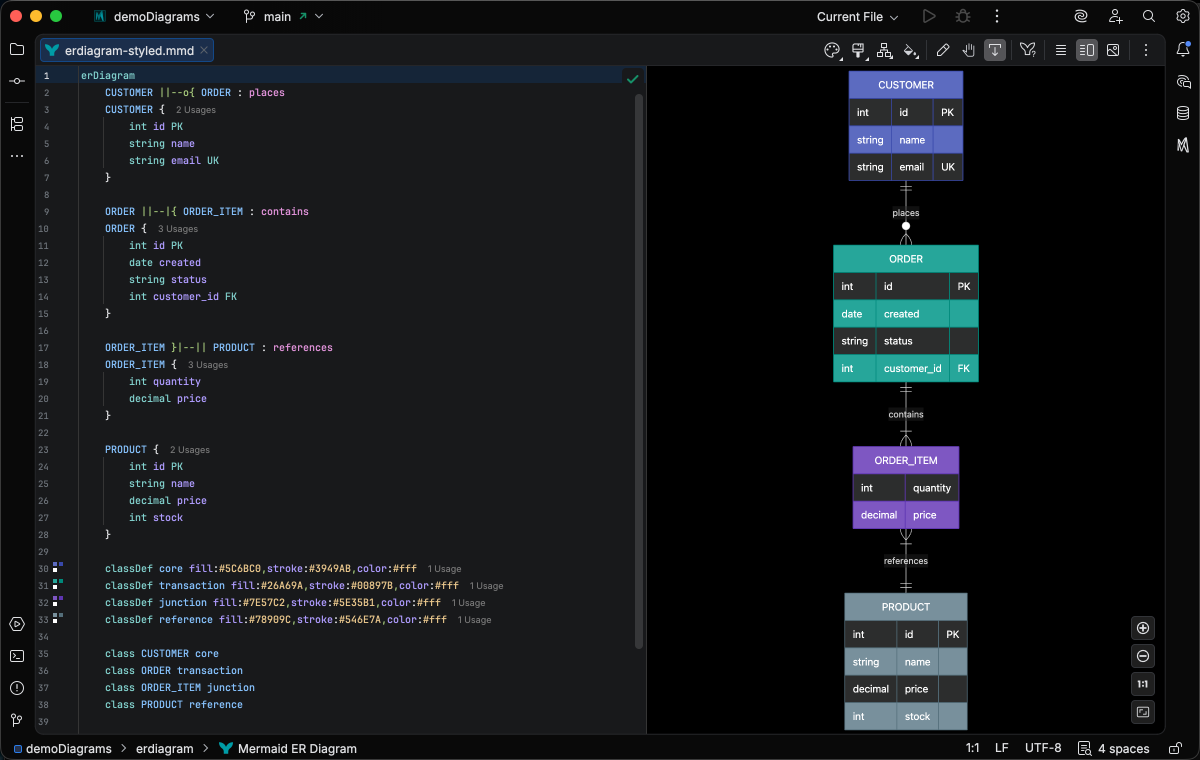
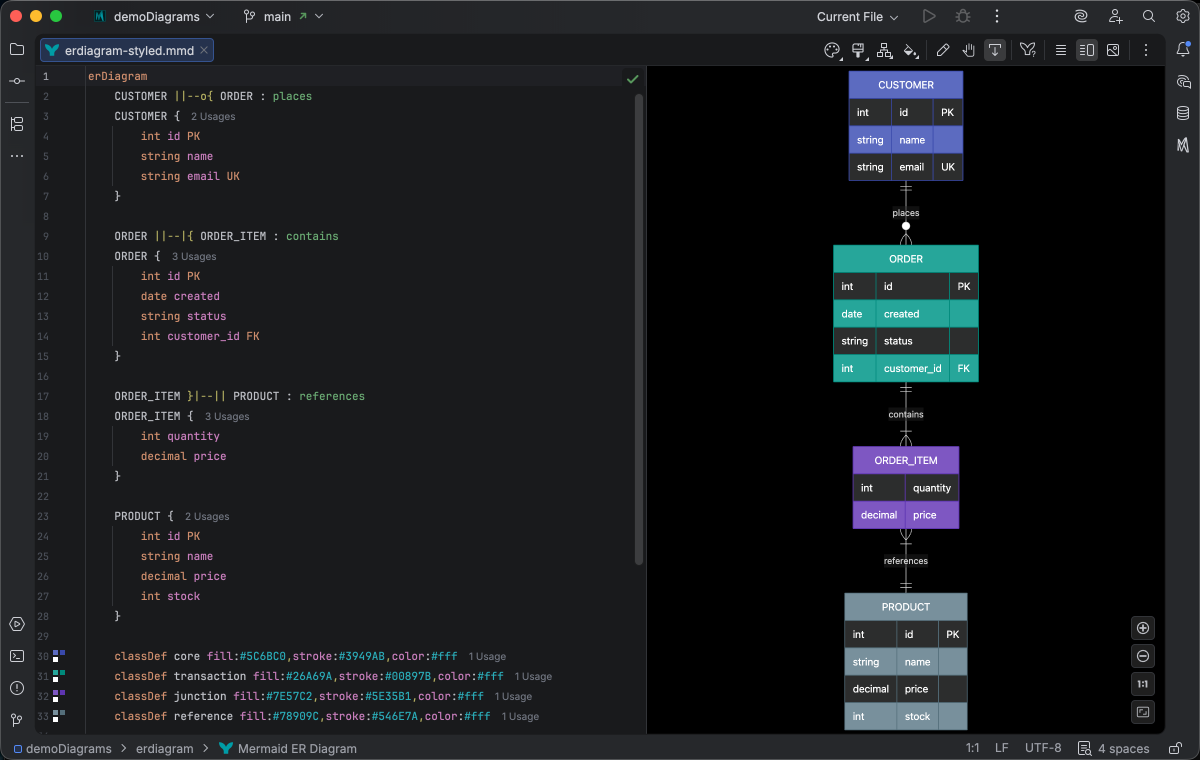
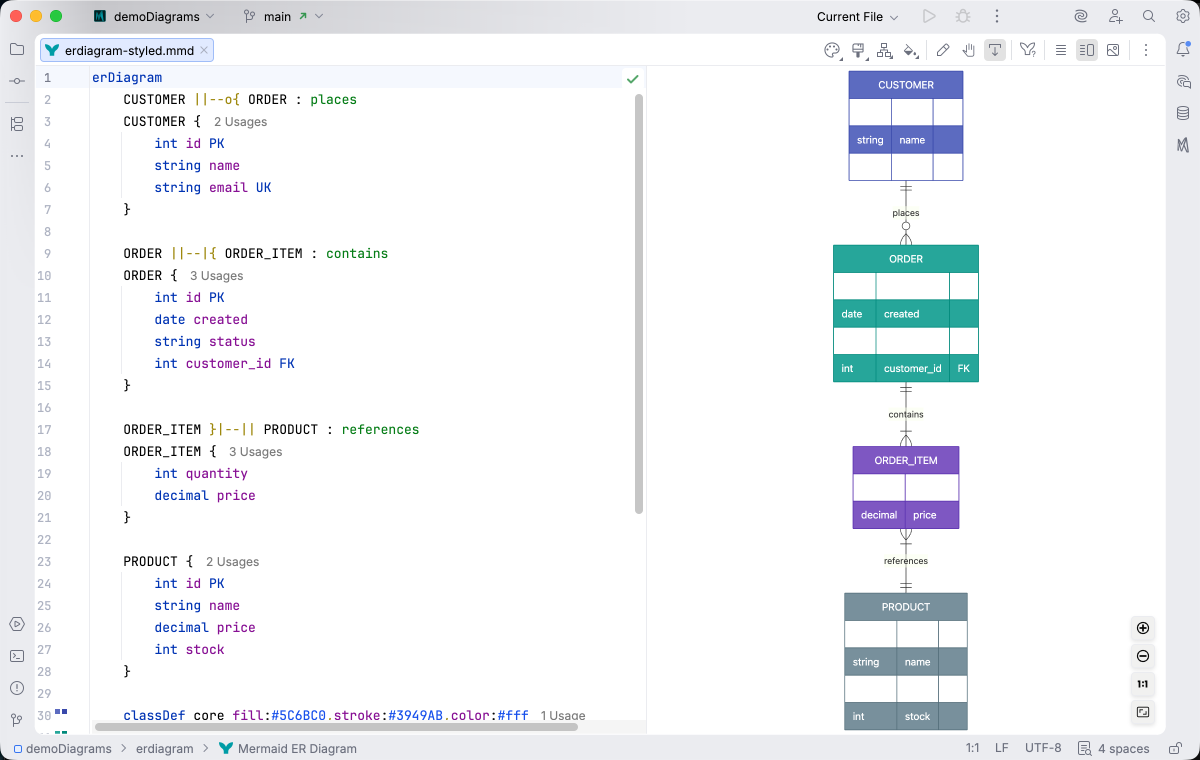
Section titled “Syntax Highlighting”Syntax highlighting integrates directly with IntelliJ’s color scheme system, so diagram colors always match your editor theme.
IDE Support
Section titled “IDE Support”The summary below shows the IDE support Mermaid Studio ships for ER diagrams, grouped by capability.
Folding lets you collapse and expand structural blocks of the diagram source (subgraphs, frontmatter, multi-line strings) directly in the editor gutter. It keeps long diagrams navigable without forcing you to scroll past detail you don’t need right now.
Use the gutter triangles, Code → Folding, or the standard JetBrains shortcuts (
When the cursor sits next to a bracket, brace, or paren, Mermaid Studio highlights its matching pair across the whole diagram and lets you jump between them. This is especially valuable in nested syntax (subgraph blocks, JSON-style style strings, multi-shape labels) where it’s easy to lose track of which closer goes with which opener.
The line-comment action (
When you type a quote character to start a string, Mermaid Studio inserts the matching closing quote and places the cursor between them. Backspacing through an empty pair removes both characters at once. This keeps quoted labels balanced and reduces fiddly cursor work.
The formatter rewrites your diagram source to a canonical layout (consistent indentation, alignment of multi-line links, normalized whitespace around operators) without changing semantics.
It also clears up the whitespace mistakes that the Mermaid.js parser is picky about, normalizing spacing between tokens so the parser accepts the diagram on the first read instead of throwing a confusing syntax error.
Run it with Code → Reformat Code (
Pressing
Live templates expand a short abbreviation into a larger snippet, with tab stops for the parts you fill in.
Type the abbreviation, press
A dedicated Grammar-Kit parser backs the highlighting, so tokens are colored by what they mean in the diagram (a type reference versus a label versus a style), not just what they look like. The same parser validates the syntax as you type, flagging malformed statements in place instead of letting one mistake cascade through the file.
This is the foundation richer features build on; the same grammar drives completions, refactoring, and inspections.
Per-diagram annotators apply rule-based highlighting above the lexer and parser, running on every keystroke and painting their results directly in the editor. Mermaid Studio uses them across the full range the platform supports: highlighting that token types alone cannot decide (coloring a reference by what it resolves to), semantic errors and warnings (an edge pointing at an undefined node, an invalid direction value), and inline cues such as marking duplicate labels. Unlike inspections (configurable checks listed in Settings), annotators are always on, whether a rule ends in a color or a warning.
As you type, Mermaid Studio offers context-aware suggestions filtered to what’s valid at the cursor: node shapes, arrow types, keywords, icon names, identifiers, frontmatter keys, theme variables, and more. Completions cut down on typos and make the diagram syntax self-documenting.
Completion and validation for the YAML frontmatter block above the diagram body, driven by the diagram type’s slice of the Mermaid.js config schema. Config keys, enum values, and color properties complete as you type, and unknown or mistyped keys are flagged in place.
Hex, named, and rgb()/hsl() colors in style declarations get a small color swatch rendered in the gutter.
Click the swatch to open the IntelliJ color picker and pick a new value, and the source updates in place.
Inspections are static analyzers that run continuously and surface problems as you edit: duplicate IDs, undefined references, malformed syntax, deprecated patterns, missing required fields. Each inspection has a configurable severity (error, warning, info), can be suppressed inline, and most ship with a quick fix that resolves the issue with one keystroke.
This is where most of the editorial intelligence lives: a diagram type with rich inspections is much harder to break in subtle ways.
Rename refactoring (
Find Usages (
Code Vision renders small inline indicators above declarations, typically reference counts (“5 references”, “3 inbound edges”), so you can see at a glance how connected an element is without running Find Usages. Click an indicator to jump to the references list.
The Structure tool window (
Bundled and user-authored color themes with light and dark variants that apply to this diagram type from the Appearance menu or the Switch Diagram Theme action. Applying a theme writes the resolved theme variables into the diagram’s frontmatter, so the file renders the same outside the IDE.
Live templates
Section titled “Live templates”A set of context-aware live templates scaffolds the entity blocks and relationship statements that ER diagrams use day-to-day. Type a short abbreviation, accept it from the completion popup, and tab through the template variables.
Individual abbreviations can be toggled under Settings > Tools > Mermaid Studio > Live Templates in the ER Diagram group. See Live Templates for the cross-cutting mechanics (triggering, contextual visibility, configuration).
Entities
Section titled “Entities”The ent template scaffolds an entity with an attribute block; enta adds a display-name alias in brackets.
| Abbreviation | Expansion |
|---|---|
ent | Entity with an attribute block |
enta | Entity with a display-name alias (NAME["Label"] { ... }) |
Relationships
Section titled “Relationships”The rel template expands the cardinality as a picker variable, so you choose the shape on insert.
The remaining templates each hard-code one cardinality for when you already know the relationship you want.
| Abbreviation | Expansion |
|---|---|
rel | Relationship with a cardinality picker |
rel1m | One-to-many, identifying (||--o{) |
rel1mn | One-to-many, non-identifying (||..o{) |
rel11 | One-to-one (||--||) |
relmm | Many-to-many (}o--o{) |
rel01m | Zero-or-one to many (|o--o{) |
rel1pm | One to one-or-more (||--|{) |
Subgraphs
Section titled “Subgraphs”The sub template scaffolds a subgraph block with its end line, so you only fill in the id and the entities it groups.
| Abbreviation | Expansion |
|---|---|
sub | Subgraph block (subgraph ID ... end) |
Subgraphs
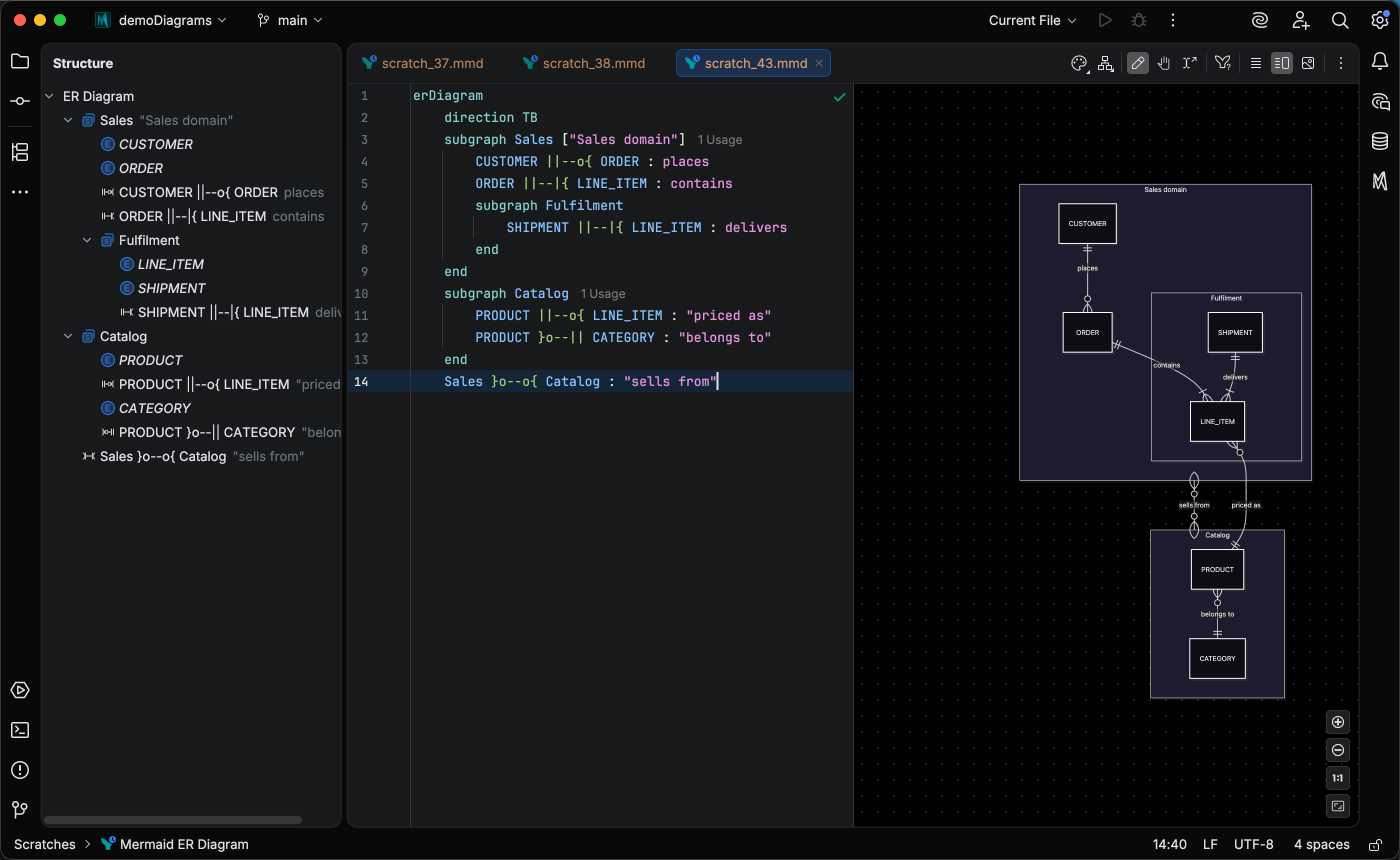
Section titled “Subgraphs”On Mermaid.js 11.17.0 or later, you can group entities into named blocks with subgraph id [Title] ... end, nest blocks inside each other, and set a direction inside a block to lay out its entities independently of the rest of the diagram.
A subgraph id works as a relationship endpoint and as a class or style target, so you can connect a whole group or style it in one statement.
Mermaid Studio treats a subgraph like any other declaration.
Press Enter after an unclosed subgraph header and the editor inserts the matching end.
Rename refactoring on a subgraph id updates every relationship, class, and style that references it, and Find Usages lists them.
Click a cluster in the preview to jump to the subgraph’s declaration in the editor.
Inspections flag an entity that shares its identifier with a subgraph, which Mermaid.js does not render, and a subgraph nested inside itself, each with a rename quick-fix.
The structure view shows the diagram as Mermaid.js renders it: each entity appears once, under the subgraph that places it.
Quick Syntax Reference
Section titled “Quick Syntax Reference”Relationship cardinality:
||- Exactly oneo|- Zero or one}|- One or moreo{- Zero or more
Common patterns:
||--o{- One to many (optional)||--|{- One to many (required)}o--o{- Many to many
Entity attributes:
erDiagram USER { int id PK string email UK int role_id FK string name }Attribute modifiers: PK (primary key), FK (foreign key), UK (unique key)
Subgraphs (Mermaid.js 11.17.0+), grouping entities into a titled block that a relationship can target as a whole:
erDiagram subgraph billing [Billing] direction LR INVOICE ||--|{ LINE_ITEM : contains end USER ||--o{ billing : ownsFor the complete syntax reference, see the Mermaid.js ER Diagram documentation.