
Quadrant Chart
Last updated:
Mermaid Studio provides language support for Quadrant charts inside IntelliJ IDEA and other JetBrains IDEs. Quadrant charts divide a space into four sections based on two axes, making them a natural fit for priority matrices, risk assessments, and strategic analysis frameworks like the Eisenhower Matrix.
Syntax Highlighting
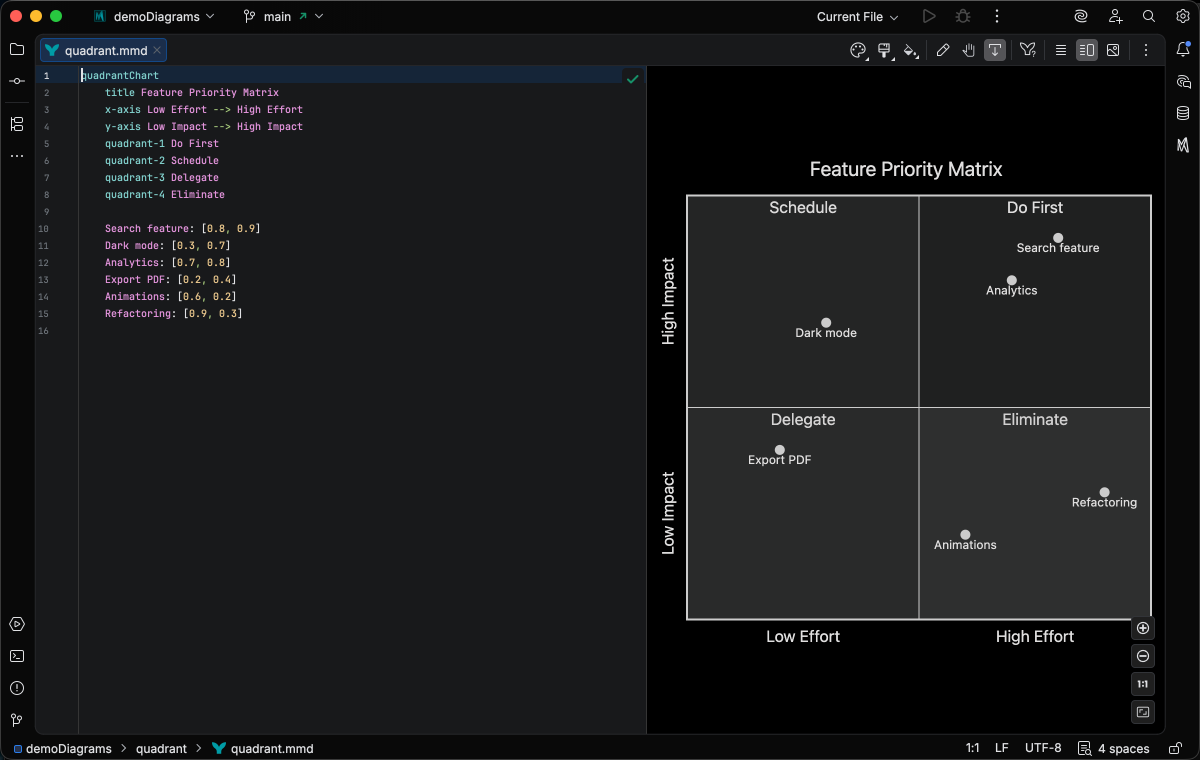
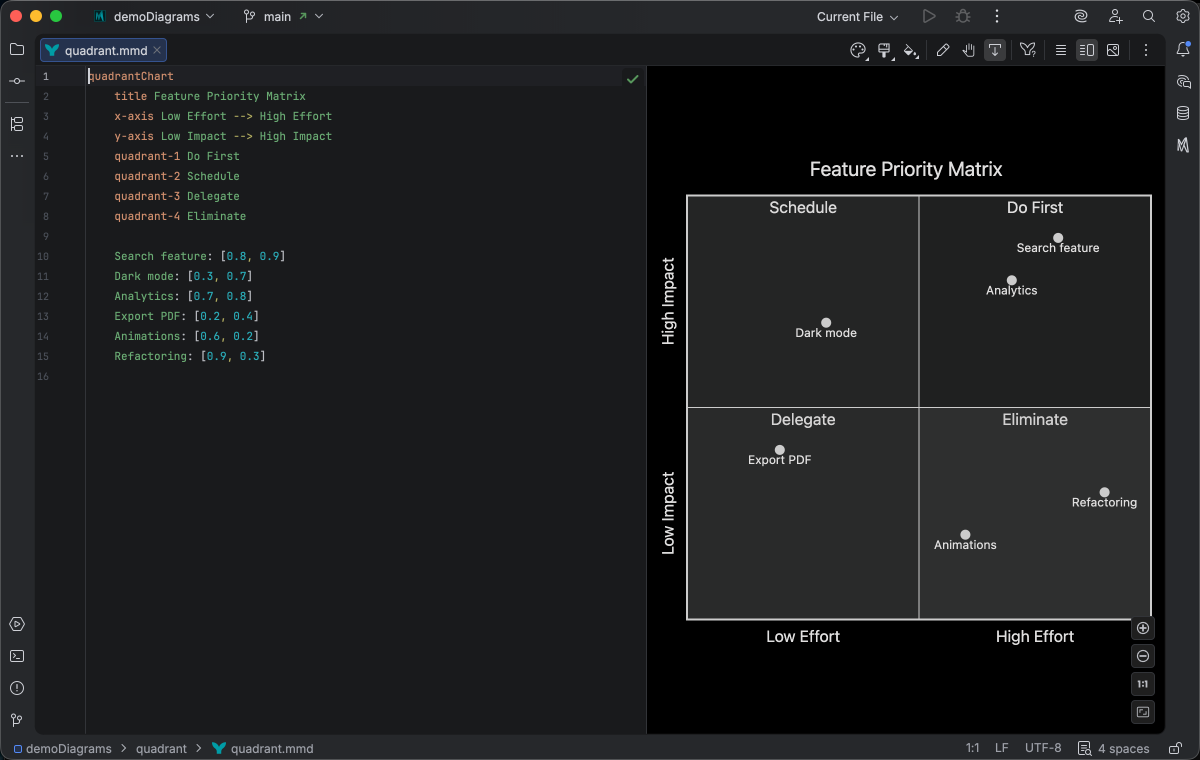
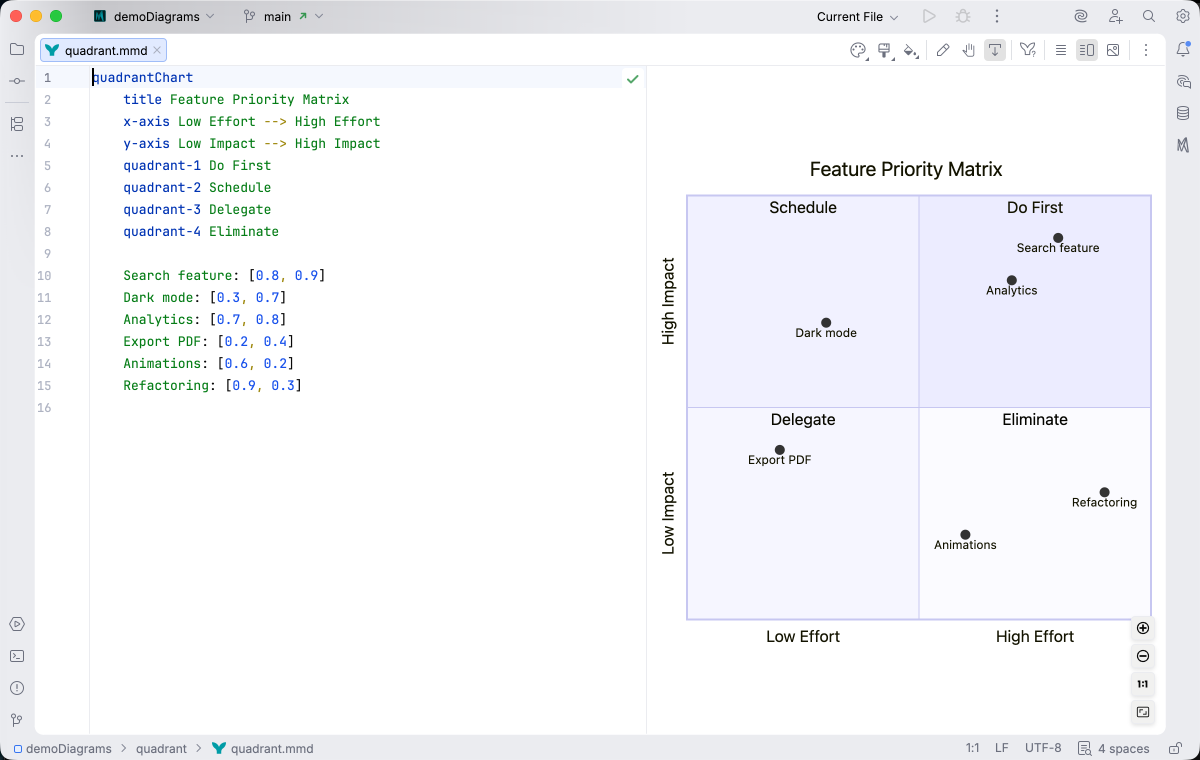
Section titled “Syntax Highlighting”Syntax highlighting integrates directly with IntelliJ’s color scheme system, so diagram colors always match your editor theme.
IDE Support
Section titled “IDE Support”The summary below shows the IDE support Mermaid Studio ships for quadrant charts, grouped by capability.
The line-comment action (
Pressing
A dedicated Grammar-Kit parser backs the highlighting, so tokens are colored by what they mean in the diagram (a type reference versus a label versus a style), not just what they look like. The same parser validates the syntax as you type, flagging malformed statements in place instead of letting one mistake cascade through the file.
This is the foundation richer features build on; the same grammar drives completions, refactoring, and inspections.
Per-diagram annotators apply rule-based highlighting above the lexer and parser, running on every keystroke and painting their results directly in the editor. Mermaid Studio uses them across the full range the platform supports: highlighting that token types alone cannot decide (coloring a reference by what it resolves to), semantic errors and warnings (an edge pointing at an undefined node, an invalid direction value), and inline cues such as marking duplicate labels. Unlike inspections (configurable checks listed in Settings), annotators are always on, whether a rule ends in a color or a warning.
Completion and validation for the YAML frontmatter block above the diagram body, driven by the diagram type’s slice of the Mermaid.js config schema. Config keys, enum values, and color properties complete as you type, and unknown or mistyped keys are flagged in place.
Hex, named, and rgb()/hsl() colors in style declarations get a small color swatch rendered in the gutter.
Click the swatch to open the IntelliJ color picker and pick a new value, and the source updates in place.
Inspections are static analyzers that run continuously and surface problems as you edit: duplicate IDs, undefined references, malformed syntax, deprecated patterns, missing required fields. Each inspection has a configurable severity (error, warning, info), can be suppressed inline, and most ship with a quick fix that resolves the issue with one keystroke.
This is where most of the editorial intelligence lives: a diagram type with rich inspections is much harder to break in subtle ways.
Rename refactoring (
Find Usages (
Code Vision renders small inline indicators above declarations, typically reference counts (“5 references”, “3 inbound edges”), so you can see at a glance how connected an element is without running Find Usages. Click an indicator to jump to the references list.
Bundled and user-authored color themes with light and dark variants that apply to this diagram type from the Appearance menu or the Switch Diagram Theme action. Applying a theme writes the resolved theme variables into the diagram’s frontmatter, so the file renders the same outside the IDE.
Quick Syntax Reference
Section titled “Quick Syntax Reference”Chart Structure
Section titled “Chart Structure”quadrantChart title Chart Title x-axis Left Label --> Right Label y-axis Bottom Label --> Top Label quadrant-1 Top Right Name quadrant-2 Top Left Name quadrant-3 Bottom Left Name quadrant-4 Bottom Right NamePlotting Points
Section titled “Plotting Points”Points are defined with a name and coordinates:
Point Name: [x, y]Coordinates range from 0 to 1:
[0, 0]is bottom-left[1, 1]is top-right[0.5, 0.5]is center
Common Use Cases
Section titled “Common Use Cases”- Priority Matrix: Effort vs Impact
- Risk Assessment: Likelihood vs Severity
- Feature Planning: Value vs Complexity
- Skill Mapping: Competence vs Interest
For full syntax details, see the Mermaid.js quadrant chart documentation.